The Adaptation Imperative: Designing a Berlin That Doesn’t Just Survive, But Thrives
The conversation around climate change is shifting. While global attention has long centered on mitigation, we are now forced to confront a more immediate reality: adaptation.
The IPCC has made it clear, we have moved beyond the question of if and into the question of how. Even under the most optimistic scenarios, the climate instability of the coming decade demands what scientists call “Transformational Adaptation”: a total reimagination of our urban environments, not merely a patchwork of fixes applied to a crumbling system.
Berlin stands at a crossroads. The city faces a triple threat, intensifying urban heat islands, volatile groundwater levels, and infrastructure built for a climate that no longer exists. The question is no longer whether Berlin must change, but how boldly it is willing to do so.
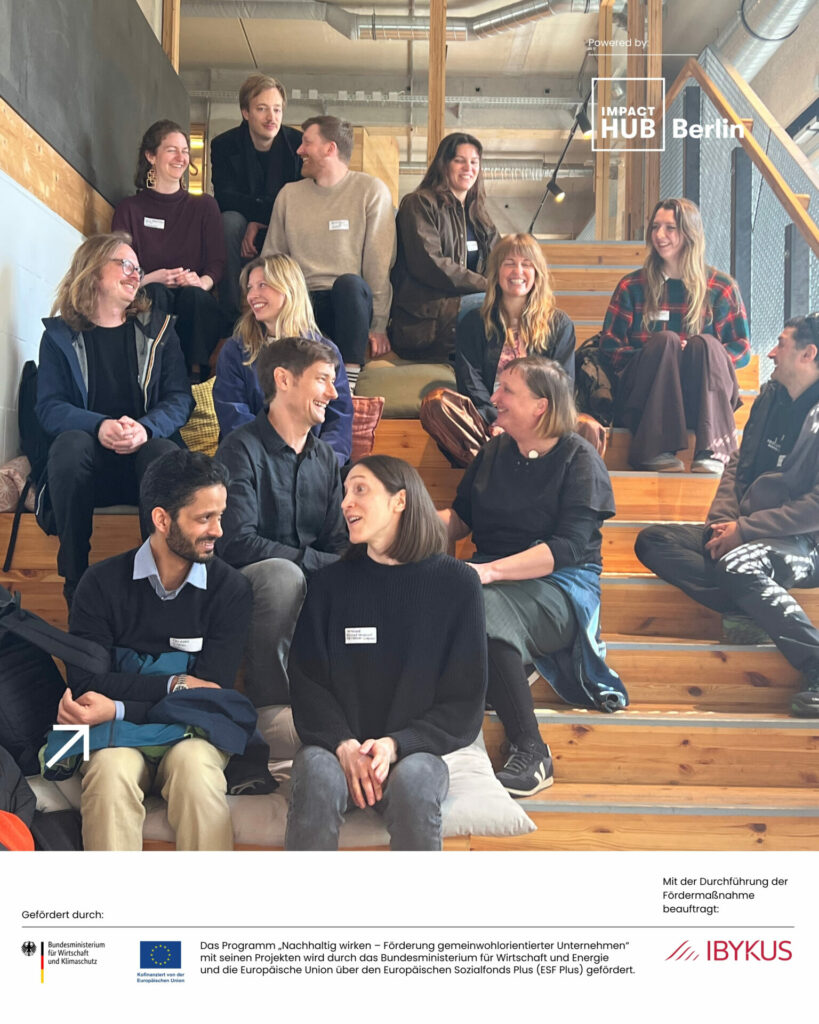
Where Trends Meet Reality
We adopted a Futures Thinking approach to focus on the practical tensions of a vulnerable city in climate change, addressing them by accelerating current trends into potential futures. Our guiding question: what does a climate resilient Berlin look like in 2036? Three themes emerged as the territory where the path forward is still being carved:
- Intelligence that serves the people: We explored “Planetary Intelligence” with a grounding realization: data is only useful if it’s accessible. How do we translate climate insights into action at the neighborhood level, ensuring that intelligence doesn’t remain locked in a lab, but reaches the streets and citizens who need it most?
- The importance of trust in a tech-enable response: Drawing on research and personal insights into social capital, participants examined the importance of communication and communities in times of disruption. We discussed “Climate First-Aid” and decentralized response networks built on trust, acknowledging that in moments of crisis, a neighbor is often the first line of defense.
- A regenerative mindset: Lastly, we turned to urban design – the long, slow work of transforming a city that drains into one that gives back. Participants shared visions of a Berlin that, building by building and street by street, becomes more sponge-like, more cooling, more alive.
Three Futures, Sketched by the Experts
To make these shifts tangible, participants moved from discussion to creation. Using futures thinking methodology, three groups sketched possible sequences of futures, speculative artifacts representing what a resilient Berlin might actually look, feel, and taste like in 2036.
Trend Cluster 1: Sense & Anticipate
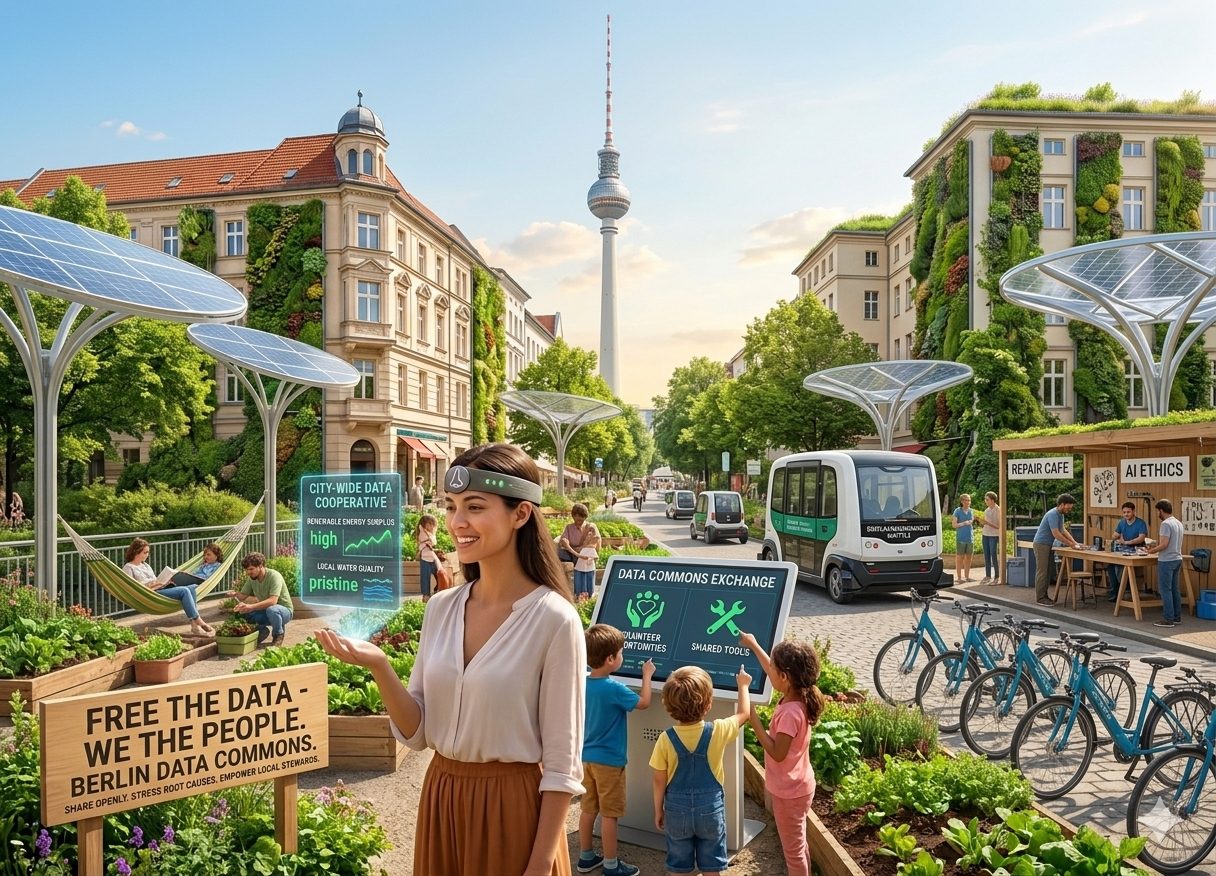
"Free the Data."
The first group focused on planetary intelligence. Their central artifact was The Carma Band, a wearable sensor that tracks personal and environmental stressors like heat and noise. Rather than data held by a distant government, their vision imagined it as a shared community resource: transparent, local, and empowering.
In their Berlin of 2036, the air smells purely fresh, and the city tastes like strawberries and local food. Their guiding value was simple: “Sharing is Caring.” They envisioned a city where self-awareness of climate impact leads to smarter resource allocation, and where high levels of mutual trust enable coordinated, meaningful action.
Trend Cluster 2: Respond and Protect
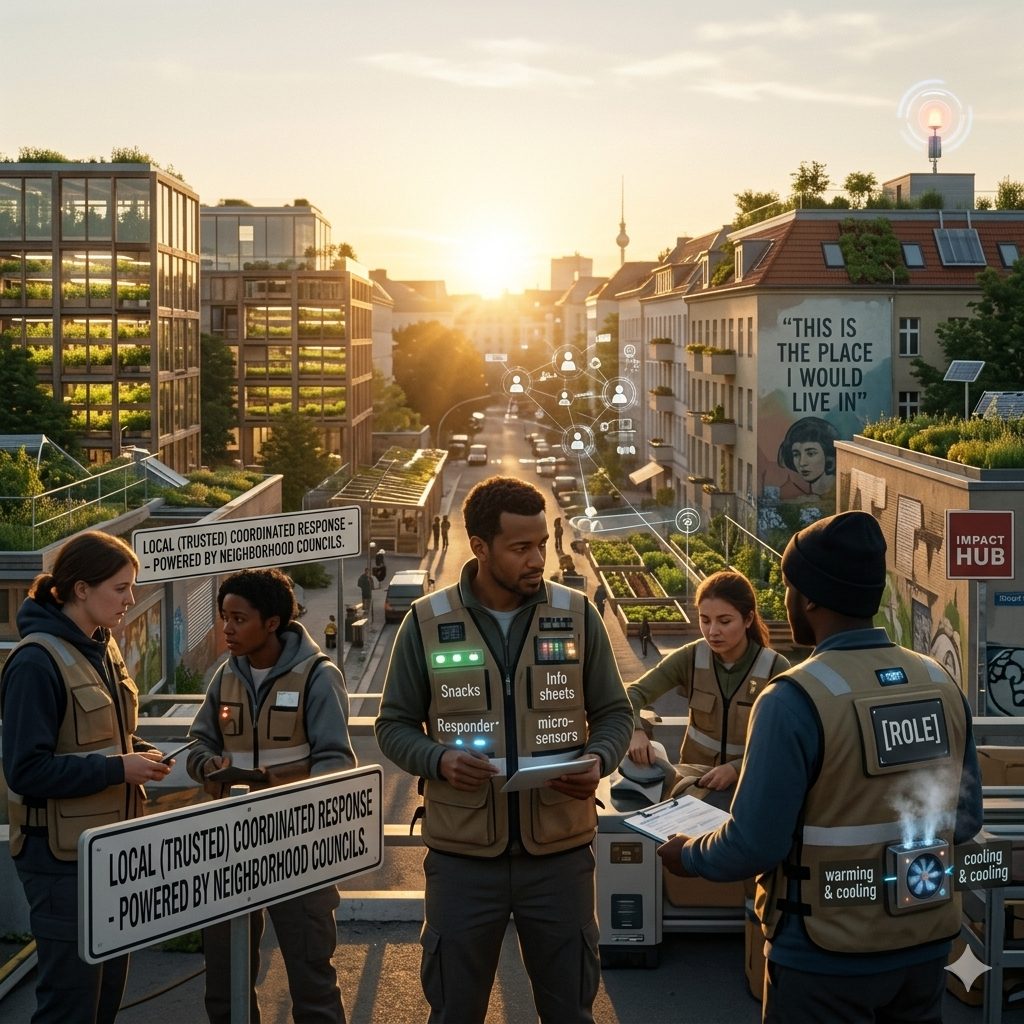
"Proactivity, community, empathy and decentralized power. "
The second group placed the human element at the heart of crisis response. Their artifact was a Modular Utility Vest, a piece of “regional fashion” equipped with crisis info-sheets, emergency beacons, and snack pockets. Functional, local, and community-oriented, it embodied the idea that resilience must be wearable and communication must be trustworthy.
Their future Berlin tasted of fresh produce from the Hinterhof and clean air. Their must-haves: proactivity, community, empathy, and decentralized power. They saw a future shaped by empowered individuals who know how to respond, supported by tech-enabled alerts that amplify rather than replace human connection.
Trend Cluster 3: Redesign and Evolve
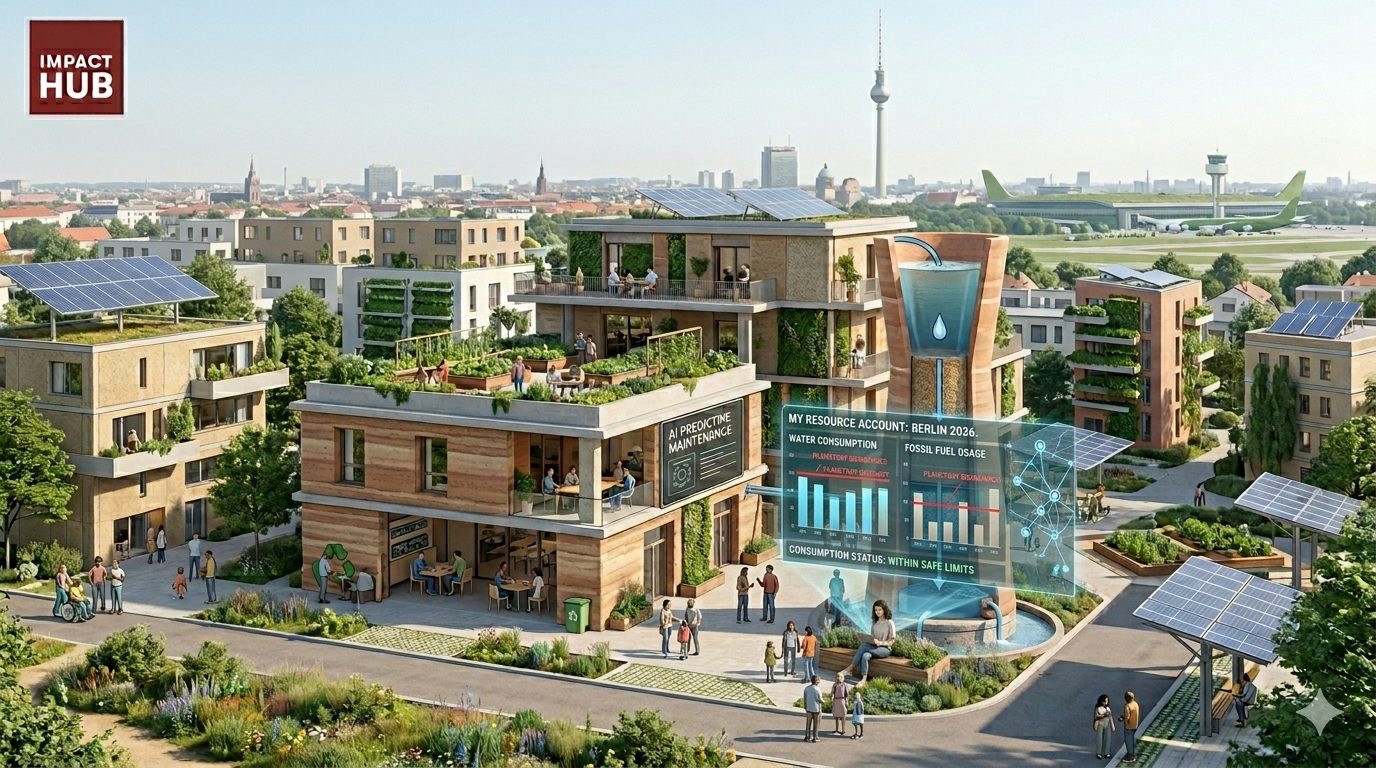
"Independent, but still connected."
The third group asked how we manage our resources when global supply chains become unreliable. Their artifact was a Handheld Empowerment Dashboard, a personal device tracking water consumption and “real-time overshoot” at the household level.
Their Berlin tasted like lemons from a Sicilian garden, and smelled of fresh air and sunscreen. Their vision rested on awareness and access: people who understand their own resource footprint and have genuine alternatives to global market dependency.
A Shadow Vision: The Data-Driven Republic
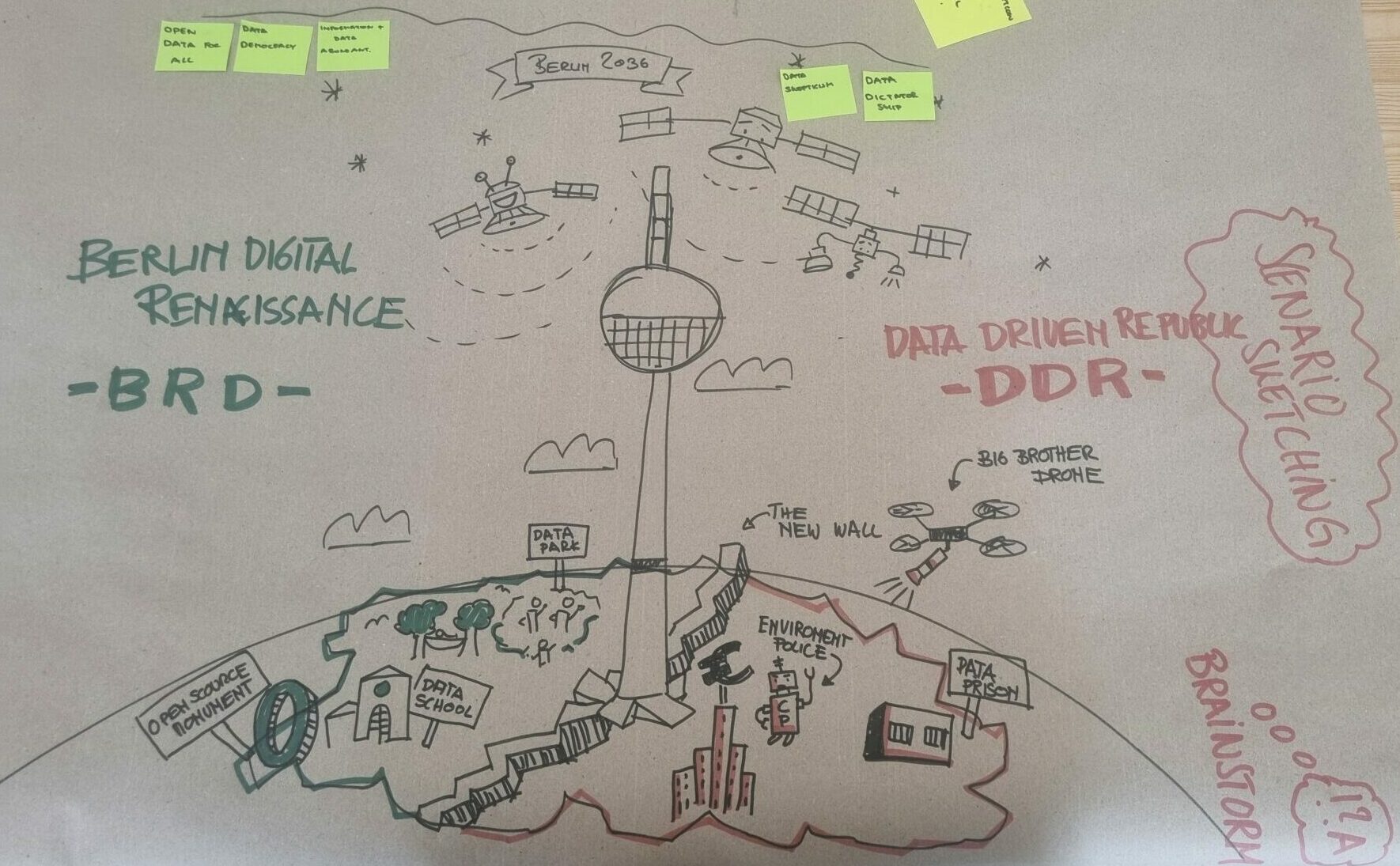
While most of the workshop focused on regenerative futures, participants also stress-tested a much darker scenario, one they called the Data-Driven Republic (DDR).
In this 2036, Berlin has not adapted through community care but through corporate surveillance and bureaucratic inertia. The air no longer smells of fresh rain; it carries the scent of burning cables and ozone. The Currywurst has been replaced by a flavorless Pulver. At the center of this dystopia is the Bionic ID, a permanent chip implant in the hand, framed as a seamless survival tool, but functioning as a mechanism of total control. Centralized authorities and private platform-owners gain unfiltered access to every citizen’s life.
This cautionary tale was essential to the exercise. It reminded the room that without social equity, the very technologies designed to protect us can just as easily become instruments of exclusion. The window for meaningful change, once missed, does not reopen easily.
What the Future Sketches Taught us
Across all three groups, a clear center of gravity emerged: community, nature, and neighborhood. Not as abstract values, but as the actual foundation of resilience. Professionals from wildly different fields arrived at the same conclusion, that meaningful change only happens when people and ecosystems are placed at the heart of it. These sketches, drawn in the heat of conversation, capture the “Aha!” moments that data alone cannot. They remind us that adaptation is as much about creativity and connection as it is about infrastructure and the right technology in place.
We want to extend our deepest thanks to everyone who joined us at the roundtable. Stepping away from daily operations to engage in deep, futures-oriented thinking is no small commitment, and your willingness to challenge our assumptions, share your expertise, and sketch the future of Berlin is precisely what makes this work matter.
Sources:
- Adger, W. N., Arnell, N. W., & Tompkins, E. L. (2005). Successful adaptation to climate change across scales. Global Environmental Change, 15(2), 77–86. https://doi.org/10.1016/j.gloenvcha.2004.12.005
- Berliner Regenwasseragentur & Berliner Wasserbetriebe. (2024). Monitoring report: Climate adaptation and the sponge city concept in Berlin. https://www.regenwasseragentur.berlin/
- Intergovernmental Panel on Climate Change. (2022). Climate change 2022: Impacts, adaptation and vulnerability. Contribution of Working Group II to the Sixth Assessment Report of the Intergovernmental Panel on Climate Change (H.-O. Pörtner, D. C. Roberts, M. Tignor, E. S. Poloczanska, K. Mintenbeck, A. Alegría, M. Craig, S. Langsdorf, S. Löschke, V. Möller, A. Okem, & B. Rama, Eds.). Cambridge University Press. https://doi.org/10.1017/9781009325844
- Intergovernmental Panel on Climate Change. (2023). Section 4: Adaptation and its limits. In Climate change 2023: Synthesis report. Contribution of Working Groups I, II and III to the Sixth Assessment Report of the Intergovernmental Panel on Climate Change (Core Writing Team, H. Lee, & J. Romero, Eds.). IPCC. https://doi.org/10.59327/IPCC/AR6-9789291691647
- Senatsverwaltung für Mobilität, Verkehr, Klimaschutz und Umwelt. (2023). Stadtentwicklungsplan Klima (StEP Klima): Klimaanpassung in der wachsenden Stadt. Berlin.de. https://www.berlin.de/sen/uvk/natur-und-gruen/klimaschutz/klimaanpassung/stadtentwicklungsplan-klima/